
Next Solar Eclipse in India (2026–2030)
Know when the next solar eclipse will be visible from India, exact timings, visibility maps, eclipse types, safety tips and upcoming eclipse dates
Upcoming Solar Eclipse visible in India: 02 August 2027
While we miss out on the 2026 eclipse, India is tracking an even bigger event right around the corner.
On August 2, 2027, a spectacular Partial Solar Eclipse will be fully visible from Delhi, Noida, and across India during the late afternoon.

Eclipse Phase Exact Time For Delhi NCR What to Expect Partial Eclipse
Begins 3:53 PM The Moon begins to step across the Sun's edge
Maximum Peak 4:29 PM The point of maximum coverage visible from Delhi
Ends 5:03 PM The Moon fully exits the solar disk right before sunset
Path of Solar Eclipse on 02 August 2027
Upcoming Solar Eclipses Visible from India
02 Aug 2027
🌞 Eclipse Type
Partial Solar Eclipse (Total over Egypt)
📍 Visibility in Delhi/NCR
30–40% Obscuration
🔭 What You Will See
The Moon covering a substantial portion of the upper solar disc during morning hours
01 June 2030
🌞 Eclipse Type
Partial Solar Eclipse (Annular over Europe)
📍 Visibility in Delhi/NCR
Partial Phase
🔭 What You Will See
A massive crescent “bite” taken out of the Sun right at sunset.
21 May 2031
🌞 Eclipse Type
Deep Partial Eclipse (Annular over South India)
📍 Visibility in Delhi/NCR
Major Obscuration
🔭 What You Will See
Northern India will witness a deep partial eclipse, while South India sees the Ring of Fire
Our Gallery: Past Solar Eclipses Captured from Delhi NCR


26 December 2019 Partial Solar Eclipse
25 October 2022 Partial Solar Eclipse
21 June 2020 Partial Solar Eclipse
Upcoming Solar Eclipses Around the World
26 January 2028
🌞 Eclipse Type
Annular Solar Eclipse
📍 Visible in India
No
06 February 2027
🌞 Eclipse Type
Annular Solar Eclipse
📍 Visible in India
No
2 August 2027
🌞 Eclipse Type
Total Solar Eclipse
📍 Visible in India
Partial Visibility
What is a Solar Eclipse?
A solar eclipse occurs when the Moon passes between the Earth and the Sun, temporarily blocking some or all of the Sun's light.
Because the Moon's orbit is slightly tilted, solar eclipses do not happen every month. They only occur during a New Moon when the Sun, Moon, and Earth align perfectly.


Types of Solar Eclipse


Total Solar Eclipse
Partial Solar Eclipse
Annular Solar Eclipse
Solar Eclipse vs Lunar Eclipse


Why Doesn't a Solar Eclipse Happen Every Month?


Solar Eclipse Myths vs Facts
❌ Myth
Solar eclipses are bad luck or bring negative energy.
✅ Fact
A solar eclipse is a natural astronomical event caused by the Moon passing between Earth and the Sun. It has no proven effect on luck or human destiny.
❌ Myth
Food becomes poisonous during a solar eclipse.
✅ Fact
Food does not become unsafe during a solar eclipse. There is no scientific evidence supporting this belief.
❌ Myth
Looking at a solar eclipse through sunglasses is safe.
✅ Fact
Regular sunglasses are not safe. Only ISO 12312-2 certified eclipse glasses or approved solar filters provide adequate protection.
❌ Myth
You can safely look at a partial solar eclipse without protection.
✅ Fact
Even during a partial eclipse, the Sun can permanently damage your eyes. Always use certified solar viewing protection.
❌ Myth
Animals can predict a solar eclipse.
✅ Fact
Some animals react to the sudden darkness as if it were dusk, but they cannot predict eclipses in advance.
How to Safely Observe a Solar Eclipse
CRITICAL SAFETY NOTE: Looking directly at the Sun without certified equipment can cause permanent eye damage or blindness. Regular sunglasses, polarizers, or unfiltered cameras are not safe.
To enjoy these rare events safely, always use professional tools:
Only Use:
ISO 12312-2 Certified Eclipse Glasses: The only reliable way to view the partial phases with the naked eye.
Solar Filters for Telescopes: If using a telescope, a certified AstroSolar Safety Film (ND 5.0) or dedicated solar filter must be securely fixed to the front aperture.
Pinhole Projection: A safe, indirect viewing method where a small hole projects an inverted image of the eclipsed Sun onto a white card or wall.
Never use:
❌ Sunglasses
❌ Camera filters
❌ CDs
❌ X-ray films
❌ Regular telescopes without certified solar filters
Looking directly at the Sun without proper protection can cause permanent eye damage.
✓ Solar eclipses occur only during a New Moon.
✓ A total solar eclipse can last up to about 7½ minutes, though most are shorter.
✓ The solar corona becomes visible only during a total solar eclipse.
✓ Total solar eclipses occur somewhere on Earth roughly every 18 months.
✓ The same location on Earth may wait centuries for another total solar eclipse.
Interesting Solar Eclipse Facts
Frequently Asked Questions
Can You See a Solar Eclipse Through a Telescope?
Yes—but only if the telescope has a certified solar filter installed in front of the objective lens
When is the next solar eclipse in India?
The next solar eclipse in India will be a partial solar eclipse on August 2, 2027, which will be visible from Delhi, Noida, and across major parts of the country during the afternoon
Is it safe to watch a solar eclipse?
Yes, but only with certified solar eclipse glasses or approved solar filters.
Will Real Sky organize solar eclipse events?
If a future solar eclipse is visible from Delhi NCR or nearby regions, Real Sky plans to organize safe public observing sessions using proper solar filters. Follow our website for announcements.
Is every solar eclipse visible in India?
No. Many solar eclipses occur over oceans or other continents.
Why can't I use sunglasses?
Sunglasses block visible light but do not provide enough protection from the Sun's intense radiation.
Check Out Our Daily Live Stargazing Session
Solar eclipses are rare events. While you wait for the next eclipse, explore the live wonders of the night sky through our professional telescope check for This Week In The Sky

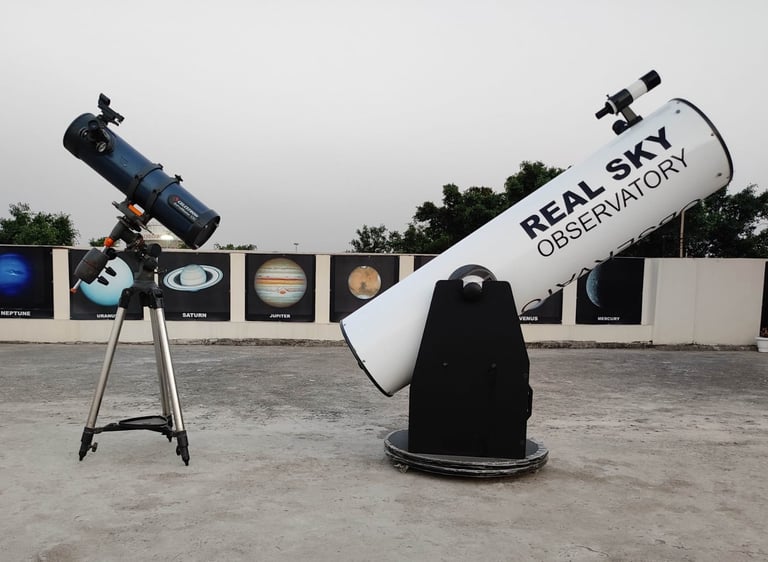
Explore More Astronomy Experiences


Browse real telescope images, visitor experiences, and stunning views captured during our public stargazing sessions.
Address
hello@realsky.in
© 2026. Real Sky Observatory. All Rights Reserved.
WhatsApp / Call
+91- 9217202436
Real Sky Observatory, at B. M Plaza Terrace, Greater Noida, India