

SaturnVenus
This Week In The Sky of Delhi NCR
Note: All visibility information on this page is based on evening sky observations from Real Sky Observatory, Greater Noida, India, and is intended as a general guide for stargazers in the Delhi NCR region.


Planet
Moon visible till 29 September
Hercules Globular Cluster M13
We Will Also Observe Live Stars
Deep Sky Object
Polaris (Dhruv Tara)
Distance: 430 Light-Years
Type: Yellow Supergiant,
Triple Star System.
The Wow Factor: 45x bigger than our Sun, shines 3,000x brighter
Albireo
Distance: 434 Light-Years
Type: Double Star System
The Wow Factor: In around 3.87 million years, Albireo will become the brightest star in the night sky
Two stars. Two colours. One system
Mizar (Vashistha)
Distance: 85 Light-Years
Type: Multiple Star System
The Wow Factor: 2.4x the size of the Sun. It looks like one star, but it's a complex 4-star system
Vega
Distance: 25 Light-Years
Type: Blue-White Star
The Wow Factor: 2.5x the size of the Sun. Vega was our North Star in 12,000 BCE and will again in the year 13,724.
Last Updated :- 21 Sep 2026
Current Status: 🌧️ Monsoon Season
Observation: On clear nights only
Recommendation: Join the waitlist to receive clear-sky alerts.
Some objects are visible only during specific parts of the night and depend on moonlight, clouds, atmospheric conditions and sky transparency.
Upcoming Astronomical Events in 2026
Venus and Moon Conjunction
14 Sep
Neptune at Opposition
25 Sep
Saturn and Moon Conjunction
20 Nov
27 Sep
24 Nov
13-14 Dec
23 Dec
4 Oct
24 Oct
Moon and Saturn Conjunction
The Geminids Meteor Shower Peak
Closest Super Moon of the Year
Pleiades Moon and Uranus conjunction
Saturn at Opposition
Saturn and Moon Conjunction
Celestial Objects Visible From Real Sky Observatory

URANUS
Observation Window
November- February
What We Can See Live
Small bluish-green disk
The Wow Factor: Uranus rotates on its side with an axial tilt of about 98°.


JUPITER- King Of Planets
Observation Window
Visible in the Evening sky from Feb 2027
What We See Live
Jupiter moon transits, Giant Red Storm, 4 Galilean Moons
The Wow Factor: It acts as Earth’s cosmic shield. Jupiter's immense gravity acts like a giant vacuum cleaner, sucking in or deflecting dangerous comets and asteroids away from us.
SATURN- Beauty Of Sky
Observation Window
From October Saturn will be in our Observation Point
What We Can See Live
Beautiful Ring Created by Universe also Its Moon Titan
The Wow Factor: Its magnificent ring system is massive—stretching 2,82,000 km wide—but ultra-thin, averaging just 10 meters thick


MERCURY
Observation Window
Currently Not visible in the Evening sky
What We See Live
we can see phases just like our moon
The Wow Factor: A year on Mercury lasts just 88 Earth days, making it the fastest planet to orbit the Sun
SUN- Our Nearest Star
Observation Window
Daytime Observation (WhatsApp us to book a solar session)
What We See Live
Active sunspots that are constantly changing their shape
The Wow Factor: It holds 99.8% of all the mass in our entire solar system. You could fit 1.3 million Earths inside it
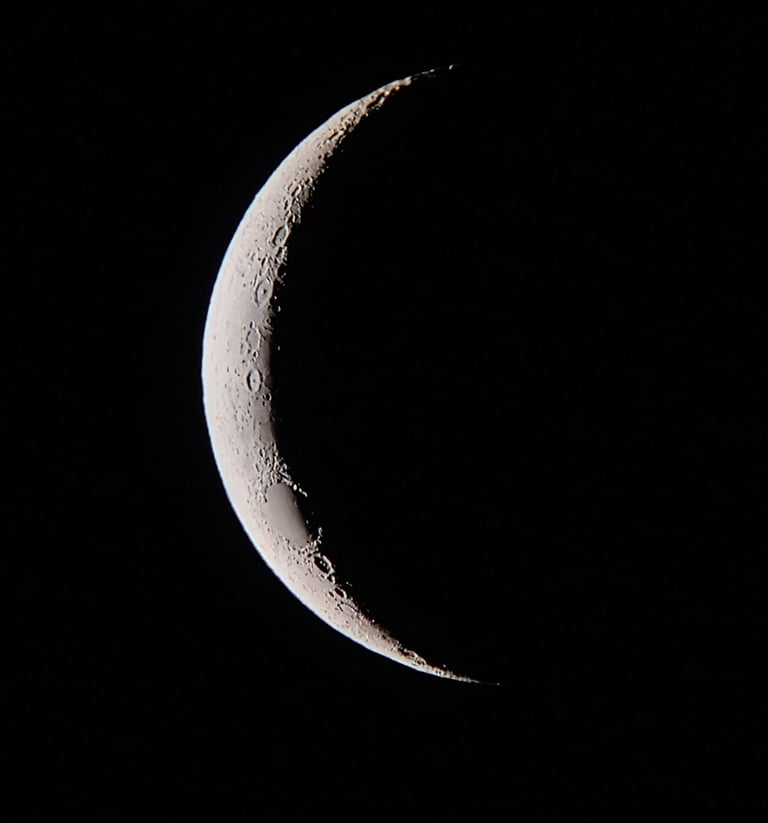
MOON
Observation Window
Visible during the evening for 15 days every month
What We See Live
Impact Craters, Lunar Mountain Ranges, and Changing Phases
The Wow Factor: Because the Moon has no atmosphere, wind, or rain, the footprints left by astronauts will remain perfectly preserved for millions of years
VENUS
Observation Window
Currently visible in the sky till Sep Month
What We See Live
Phases and Atmosphere on its surface
The Wow Factor: It is the hottest planet in the solar system —hot enough to melt lead! It also rotates backward, meaning the Sun rises in the west and sets in the east.


MARS- The Red Planet
Observation Window
Will visible from Feb 2027
What We See Live
Orange-red disk
The Wow Factor: Mars is home to Olympus Mons, a volcano three times taller than Mount Everest. It is so massive that its base would cover the entire state of Uttar Pradesh!
Deep Sky Objects
Orion Nebula (M42)


Observation Window
December – March
What We Observe
Gas cloud, Trapezium star cluster, Nebular structure
The Wow Factor: Located 1,344 light-years from Earth Inside it new stars being born right now.


Pleiades (M45)
Observation Window
November – March
What We Observe
Bright blue star cluster, Dozens of young stars
The Wow Factor: Often called the "Seven Sisters"


Hercules Cluster (M13)
Observation Window
May – Sep
What We Observe
Dense spherical star cluster, Hundreds of resolved stars
The Wow Factor: Contains several hundred thousand stars
Keep Exploring the Night Sky


Solar Eclipse Guide



Find out what else is visible through our telescope, including planets, deep-sky objects, and upcoming astronomy events.
Address
hello@realsky.in
© 2026. Real Sky Observatory. All Rights Reserved.
WhatsApp / Call
+91- 9217202436
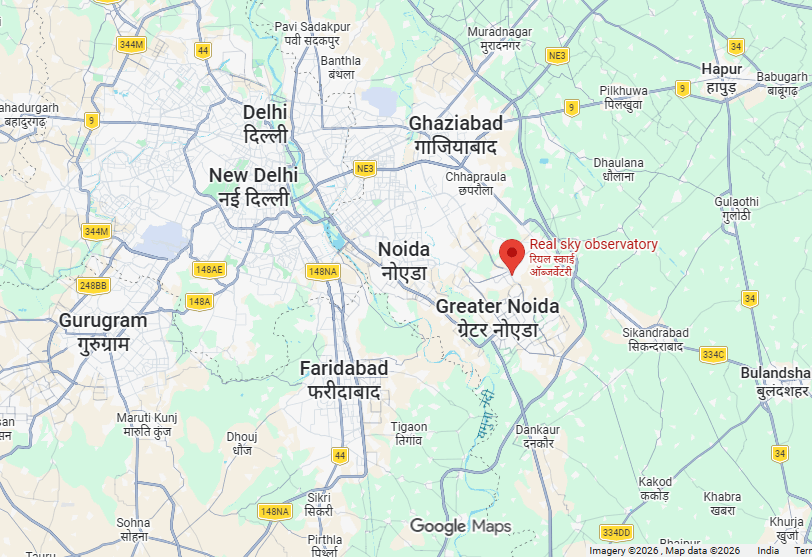
Real Sky Observatory, at B. M Plaza Terrace, Greater Noida, India